Why the Harmonica is So Cool
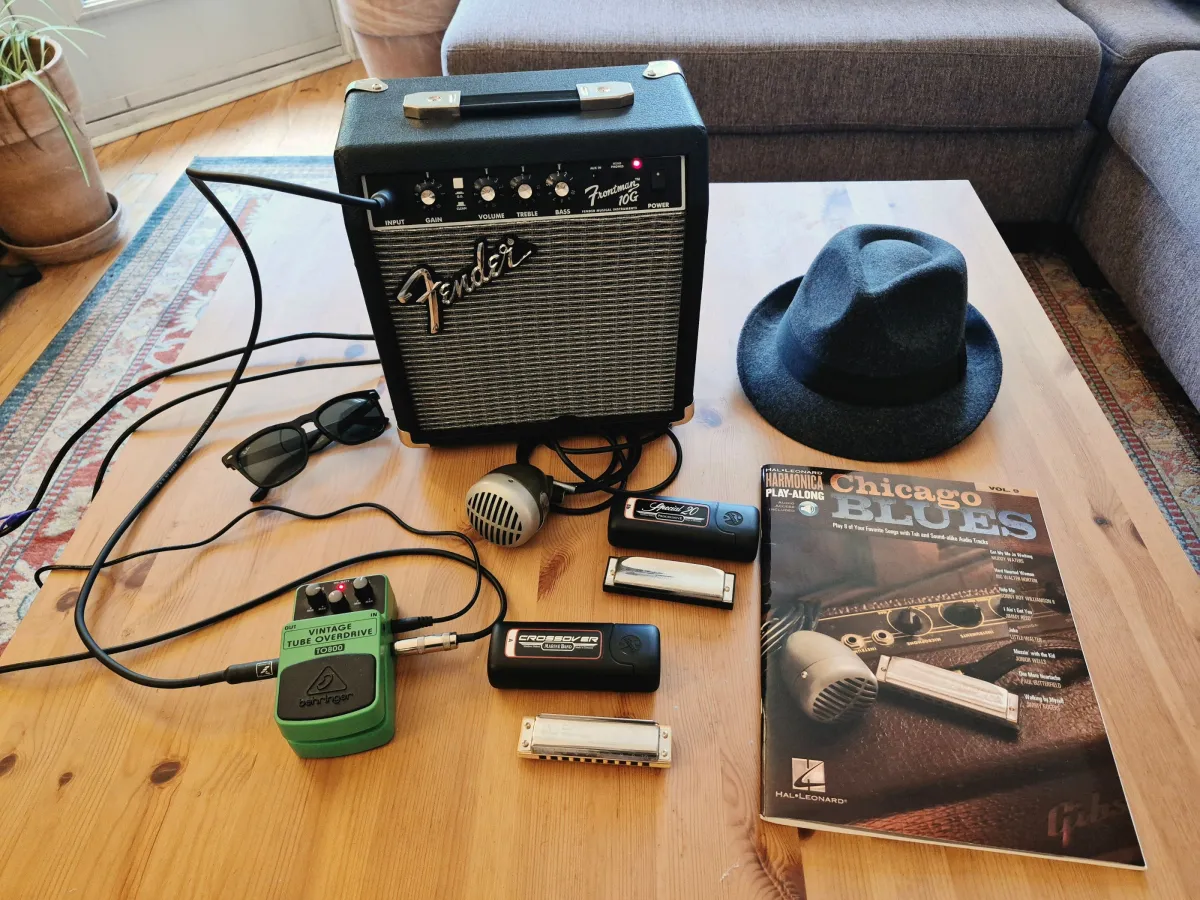
The harmonica is an instrument that was not designed to be cool. But thanks to what Howard Levy calls "one of happiest accidents in the history of music," it is. Case in point: In the hands of bluesman Little Walter, the harmonica became so thoroughly cool that, in 1952, his instrumental song "Juke" hit number one on Billboard's R&B chart—and stayed there for eight weeks. (Little Walter played both as a soloist and bandmate of the legendary Muddy Waters.) Can you imagine someone doing that with an accordion?
But the harmonica is the accordion's close kin, and the accordion is naturally associated with the kind of music that...some people...consider uncool: waltzes, ländlers, polkas, marches, hymns, and sentimental parlour tunes, and so on. Not, in other words, the kind of music that people associate with Ray-Bans, whiskey, juke joints, fedoras, tube amps and bullet mics...in other words, the blues. In fact, the blues musical style didn't even exist in 19th-century Germany where and when the 10-hole diatonic harmonica—what cool people today refer to as the blues harp—was invented. (Diatonic means that it's tuned to play a single major scale, such as C major; a chromatic instrument such as the piano can play songs in any key.) So how did this happen? How did the harmonica become so cool?
Around the turn of the 20th century, inexpensive Hohner Marine Band harmonicas became widely available in the Mississippi Delta (and other areas in the American South) where the blues style was emerging. At the time, these instruments were largely perceived as cheap novelties that were effectively useless for playing the blues. Take, for example, the C major harmonica (by far the most common harmonica key), which is designed to play the C major scale (C - D - E - F - G - A - B - C). From the blues perspective, it appears to be fatally flawed: it can't play the dominant 7th C chord (C - E - G - B♭) used in the blues, nor can it play the associated blues scale (C - E♭ - F - G♭ - G - B♭ - C).
Given these limitations, it would seem the harmonica could not possibly become cool...except for that happy coincidence Howard Levy mentioned. Back in the Delta, Black musicians discovered something utterly unexpected: by reversing their breath direction when playing traditional types of harmonica songs, a blues shuffle almost magically emerges from the instrument—but in the "wrong" key!
For the C harmonica, that key is G. Why? Because the draw (inhale) notes in holes 2 through 5 are G - B - D - F, which happens to form the dominant 7th chord required for playing the blues in G. The harmonica's draw note layout also readily facilitates blues-style note progressions. Still, the B♭ and D♭ notes needed to play the G blues scale (G - B♭ - C - D♭ - D - F - G) are missing. Or...are they?
Another unintended feature of the harmonica is that, by changing the shape of one's embouchure, one can bend certain notes, in a way similar to bending notes on the guitar (although harmonica bends lower the pitch, whereas guitar bends raise it). With enough practice, the missing B♭ and D♭ notes can actually be played on the C harmonica.
Taken together, the C harmonica becomes a remarkably expressive blues instrument, but for songs in the key of G. Blues players call this playing cross-harp, because it goes against the grain of how the harmonica was designed to be played. (Note that this is also called second position; in fact, the C harmonica is also frequently played in third position for blues in the key of D) .The same principle applies to the other harmonica keys; for example, the D harmonica is often played cross-harp for blues songs in the key of A, and in third position for songs in E. In short, the blues players of the Delta figured out that by playing the harmonica in the wrong key on purpose, they could unlock a supremely cool and expressive blues instrument.
I've been playing the harmonica for around three years, and I remember exactly what got me into it: I was sitting on my couch listening to music and my streaming app played a Blues Traveler song. I used to listen to them a lot and was always amazed at John Popper's preternatural ability to shred the harmonica like a guitar hero; but it had never occurred to me that I should pick up the instrument myself. Sitting on the couch that day it suddenly occurred to me that I too, with enough grit, might one day become a harmonica hero. I promptly purchased a Hohner Special 20 in the key of C, signed up for some online lessons from Howard Levy and got to work. What I love about the harmonica is that it is, in many ways, much like the eclectic guitar in that it is an incredibly expressive instrument—you can play both chords and melodies, and create many effects including bends, wah-wahs, tremolos, glissandos, and tongue-blocked octaves; like Little Walter, you can amplify it through a bullet mic and tube amp for the ultimate overdriven Chicago blues sound. In short, with enough practice you can really make the harmonica sing. Listening to players like Little Walter, Sonny Boy Williams, and John Popper, the one word that repeatedly comes to mind is: cool.
So naturally you are now thinking: yes, but has playing the blues harp made you cool? I like to think so; or at least, maybe partially cool. This very discussion brings to mind Hunter S. Thompson's 1972 essay "Fear & Loathing in Los Vegas," in which he attends a sheriff's conference and mocks the keynote speaker's book:
Dr. Bloomquist's book is a compendium of stale bullshit. On page 49 he explains the "four states of being": "Cool, Groovy, Hip & Square"—in that descending order. "The square is seldom if ever cool," says Bloomquist. "He is 'not with it,' that is, he doesn't know 'what's happening.' But if he manages to figure it out, he moves up a notch to 'hip.' And if he can bring himself to approve of what's happening, he becomes 'groovy'. And after that, with much luck an perseverance, he can rise to the rank of 'cool.'"
On that scale, the harmonica is definitely cool. The accordion is unquestionably square. And me? Thanks to the blues harp, I've moved up in the world. I might not be cool yet, but I'm definitely not square. I might even be groovy. But I'll let you decide.